Study: Genesis 18:1 – 22:24
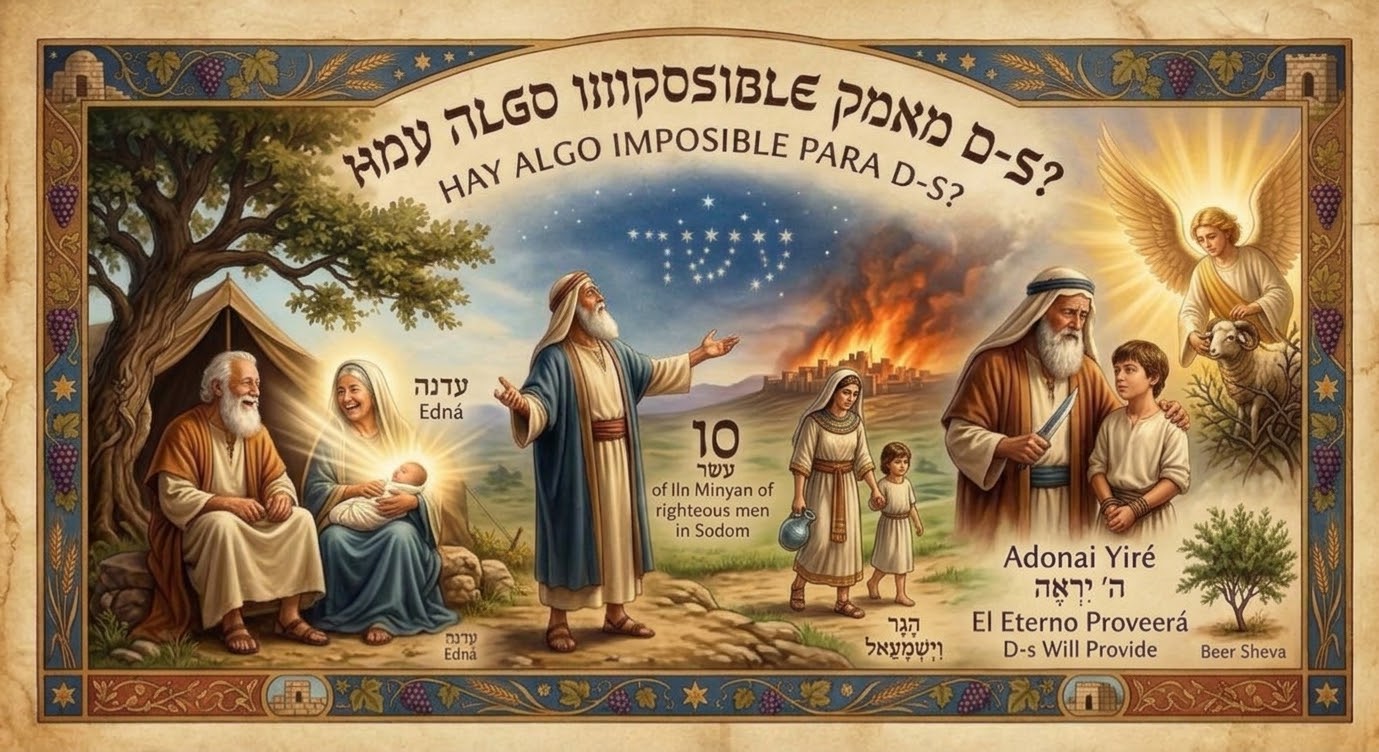
Is Anything Impossible for G-d?
1. Abraham’s Hospitality (Hachnasat Orchim): The Art of Empathy and Unselfish Generosity
The beginning of Parashat Vayera (Genesis 18:1–8) places Abraham sitting at the entrance of his tent in the terebinths of Mamre, during the heat of the day.
Despite recovering from his circumcision at ninety-nine years old, his attention was not focused on his own pain or physical discomfort, but on actively seeking someone to serve.
Promptness and Insistence in Service:
Upon spotting three unknown travelers, Abraham did not wait to be approached; he ran to meet them, bowed, and earnestly insisted that they accept his shelter before continuing their journey. He humbly offered them “a little water and a piece of bread,” but the Torah reveals that his generosity far exceeded what was promised: he coordinated with Sarah to prepare cakes of fine flour and personally ran to the herd to select a tender and choice calf, serving them butter, milk, and the prepared feast himself.
Ethical and Psychological Lesson (Promising Little and Doing Much):
The Sages of the Talmud (Tractate Bava Metzia 87a) highlight this passage as the paradigm of the soul’s nobility: the wicked promise much and deliver nothing, while the righteous promise little and perform deeds of great generosity. Abraham taught that true hospitality is not a formal act of courtesy, but a proactive attitude of love toward one’s neighbor (Chesed).
Receiving People Is Receiving the Divine Presence:
The biblical text shows Abraham interrupting his direct communion with the Divine Presence (Shechinah) to attend to the three strangers. From this, the Sages derive one of the highest maxims of Jewish ethics: “Greater is the hospitality shown to guests than receiving the Divine Presence.” Serving human beings in a concrete way is the most sublime form of honoring the Creator. This attitude of complete openness is what opens the door to the announcement of the miracle.
2. Is Anything Impossible for G-d?
The central core of the biblical announcement is found in Genesis 18:14: “Is anything too hard for the Eternal?” (Hapele meAdonai davar?).
Faced with the divine promise of a son, the limitations of the human condition immediately arise:
Advanced Age: Abraham and Sarah were at a biologically unproductive stage according to the laws of medicine and physiology.
Sarah’s Reaction: Laughter welled up before the physical impossibility (“After I have grown old, shall I have pleasure, my lord being old also?”). Subsequently, upon being discovered by the Creator’s Omniscience, she denied having laughed out of fear.
The Divine Response: G-d reminds her with tenderness, yet absolute firmness: “No, but you did laugh.”
This scene contains a profound psychological reading of our fragility: human beings, in the presence of our Heavenly Father, frequently react like young children. We attempt to deny the obvious before Divine Omniscience, revealing our initial doubts and incredulity in the face of an impending miracle.
3. The Word Ednah: The Pleasure and Sanctity of Marital Lover
Sarah exclaims internally: “After I have grown old, shall I have pleasure (ednah / עֶדְנָה)?”
The Hebrew word עֶדְנָה (Ednah) shares the same root as the word Eden (the Garden of Eden). It literally means pleasure, delight, rejuvenation, and physical/emotional delicacy.
Intimacy in Judaism: Beyond Procreation
Unlike ascetic approaches present in other religious traditions—where marital intimacy has historically been viewed as a “necessary evil” solely intended for reproduction—the Torah and authentic Jewish tradition consecrate sexual pleasure within marriage as a sacred act in itself.
The Precept of Onah: In the Torah (Exodus 21:10), the husband has an ethical and spiritual obligation to provide regular intimacy and pleasure to his wife, regardless of her reproductive capacity (even during pregnancy, lactation, or post-menopause).
Spiritual Connection (Devekut): The Talmud and the Sages of Kabbalah teach that when spouses unite with love, respect, and mutual desire, the Divine Presence (Shechinah) dwells in their home. Marital pleasure is not a sin; it is the vehicle of sanctification to bind two souls together.
The Marriage of Abraham and Sarah
Sarah’s expression reveals fundamental aspects regarding the strength of their union:
Mature Love and Desire: Sarah did not reduce her existence to motherhood as a simple mechanical duty; she embraced the emotional and physical dimension of mature love.
Lifelong Companionship: After decades of overcoming famines, migrations, conflicts, and the pain of sterility, the desire for intimacy, affection, and mutual partnership remained alive between them.
Rejuvenation: The root Ednah suggests that emotional self-giving renews the marital bond: physical and emotional intimacy keeps the couple spiritually young, defying the biological passage of time.
Even in the most rigorous halachic codification (Shulchan Aruch), it is categorically established that marital intimacy performed out of mere obligation, or lacking affection and mutual delight, lacks holiness. Sarah and Abraham represent the paradigm of a true marriage: one where affection, attraction, and delight (Ednah) build the sanctuary where the Creator chooses to dwell.
4. Abraham’s Intercession for Sodom and the Origin of the Minyan
When Abraham pleads for the salvation of Sodom, he challenges the Judge of all the Earth: “Will You also destroy the righteous with the wicked?” (Genesis 18:23). In his prayer of intercession, he persistently negotiates from fifty down to ten righteous individuals.
The Sages saw in Abraham’s negotiation for ten righteous people one of the conceptual antecedents associated with the subsequent development of the Minyan.
The Sages of the Talmud (Tractate Megillah), through the rule of verbal analogy (Gezerah Shavah), deduce that a community sanctified before the Divine Presence requires at least ten members, using as a reference the ten righteous who could have saved Sodom. Wherever ten people gather with a sacred purpose, the Shechinah rests there.
5. The Culture of Sodom, Lot’s Daughters, and Redemption Through Ruth
Sociocultural Context and Genetic-Medical Analysis
Lot’s daughters grew up in Sodom and absorbed the anti-values of that morally collapsed society. Following the catastrophe (Genesis 19), isolated in a cave and operating under the assumption that all humanity had perished, they resorted to direct endogamy to ensure offspring.
From a medical and biological perspective (population genetics), reproduction between first-degree relatives (incest) drastically increases homozygosity, elevating the expression of defective recessive genes, malformations, and severe hereditary diseases.
For this reason, the Torah categorically forbade these unions in Leviticus 18 to safeguard the ethical order and generational health. In the patriarchal era prior to the giving of the Torah at Sinai, family dynamics responded to extreme survival circumstances.
The Lineage of Moab and the Redemptive Figure of Ruth
Although the Moabite people descended from Lot’s elder daughter (Genesis 19:37), human destiny is not irrevocably buried by the past or sociocultural heritage.
Deuteronomy 23:3 prohibited Ammonites and Moabites from entering the congregation of Israel due to their cruelty in failing to provide aid to the people in the wilderness. However, the oral tradition (Talmud, Tractate Yevamot 69a) establishes the legal precision: “Moabi velo Moabit” (the prohibition applies to the Moabite male, not the Moabite female).
Rabbinic analysis determined that the lack of hospitality fell upon the men who administered the city, keeping the path of repentance open for the sincere woman.
Ruth the Moabite embodies the complete rectification of Sodom’s degradation:
1. From Cruelty to Chesed (Lovingkindness): In contrast to Sodom’s selfishness, Ruth demonstrates selfless love by abandoning her homeland and status to accompany her mother-in-law Naomi (Ruth 1:16).
2. Rectification of Intent: Unlike the secrecy in Lot’s cave, Ruth’s approach to Boaz (Ruth 3) takes place within the formal framework of levirate marriage (Yibum), before the elders and with absolute moral dignity.
3. Conversion Out of Pure Faith: Ruth embraces monotheism out of personal conviction, becoming the great-grandmother of King David and the ancestor of the messianic lineage. Her story demonstrates that character rectification and goodness transcend any stigma of the past.
6. The Family Drama: Sarah, Hagar, and Ishmael
1. Human Rashness: Sarah’s decision to hand over Hagar stems from the pain of barrenness. It represents the human inclination to force events when a divine “delay” is perceived. However, the Creator’s purpose is not established through shortcuts or convenient solutions, but within the framework of faith inside legitimate marriage.
2. The Marital Principle: In Genesis 21:12, G-d instructs Abraham: “Listen to whatever Sarah tells you.” The Eternal confirms that the covenant promise will pass exclusively through Sarah’s line. Simultaneously, He guarantees Ishmael’s preservation (“I will make him a great nation”), distinguishing the general blessing from the covenant inheritance.
3. Blindness and Spiritual Illumination: In Genesis 21:19, when Hagar collapses in the wilderness, the text notes: “Then G-d opened her eyes, and she saw a well of water.” The well had always been there, but anguish clouded her perception. This teaches us that divine help is often right around us; we require the Eternal’s intervention to remove our emotional blindness and allow us to perceive the solution.
7. Abraham and Abimelech: Integrity, Conflict Resolution, and the Eshel
The encounter at Beer Sheba (Genesis 21:22–34) demonstrates Abraham’s testimony before the nations:
External Recognition: Abimelech and his general Phicol acknowledge: “G-d is with you in all that you do.” The integrity and moral walk of an individual project undeniable respect even before adversaries.
Justice and Transparent Communication: Before ratifying peace, Abraham confronts Abimelech over the wrongful seizure of a water well by Abimelech’s servants. Genuine peace does not ignore problems; it resolves them on the foundations of truth, restitution, and clarity.
The Tamarisk Tree (Eshel): Abraham plants an Eshel at Beer Sheba (Genesis 21:33). The Sages (Talmud, Sotah 10b) read in the word אֶשֶׁל (Eshel) an acronym for Achilah (Food), Shtiyah (Drink), and Levayah (Lodging/Escort). Abraham transformed his abode into a place of universal welcome where, upon receiving gratitude, he redirected hearts toward the Creator.
8. The Akedah (Genesis 22): Abolition of Human Sacrifice and the Revelation of Adonai Yireh
The binding of Isaac constitutes the pinnacle trial of the Parashah:
1. Overcoming Paganism: Abraham came from Ur of the Chaldeans, a culture immersed in cults demanding child sacrifice. Through the trial of the Akedah and the substitution of the young man with the ram, the Eternal forcefully declared that the G-d of Israel abominates the blood sacrifice of children. The Creator demands life, ethical dedication, and spiritual elevation, closing the door forever on pagan practices of ritual infanticide.
G-d never desired the death of Isaac; He desired the heart of Abraham.
2. The Certainty of Faith (“We Will Return”): In Genesis 22:5, Abraham tells his servants: “We will go over there and worship, and then we will return [in the plural] to you.” Abraham was not resorting to deception; he fully trusted that the promise given through Isaac would be fulfilled and that they would return together.
3. The Nobility of Isaac: According to the Midrash, Isaac was a fully conscious man who accepted the act with reverence and moral strength, embodying the attribute of Gevurah (self-control, discipline, and inner righteousness).
4. Adonai Yireh: Genesis 22:14 seals this passage with the revelation of the Name Adonai Yireh (“The Lord Will Provide / The Lord Sees”).
At the point of greatest trial, Providence reveals the way out. This concept transcends the biblical narrative to become a living reality in our personal lives: the certainty of divine faithfulness.

