Shabbat, October 24, 2026 | 13 Cheshvan 5787
A reflection on Abraham’s call, faith in times of uncertainty, integrity, divine provision, and the purpose the Eternal reveals to those who dare to walk with Him.
Parasha Readings:
Genesis 12:1–17:27
Haftorah:
Isaiah 40:27–41:16
Introduction: “Go Toward Yourself”
The divine command that opens this portion is one of the most transformative in the entire Torah:
“Lech Lecha” (לֶךְ־לְךָ).
It does not simply mean “go.” It can also be understood as “go for yourself,” “go toward yourself,” or “set out on the path toward the person you are meant to become.”
The Eternal calls Abram to leave his land, his birthplace, and his father’s house. He asks him to leave behind everything that had until then defined his identity.
As Rabbi Jonathan Sacks z”l taught, only one who is willing to be different can encounter the One God. Only one who dares to detach from inherited identities can discover the identity the Creator has reserved for him.
Often, to truly find ourselves, we must distance ourselves from the voices that shaped us, from others’ expectations, and from the attachments that limit our spiritual growth.
Why Was Abram Chosen?
The Torah does not give an explicit explanation of why Abram was chosen. Yet the Midrash offers a window into his character.
From a young age, Abram questioned the idolatry of his surroundings. He observed how people worshiped images and forces of nature, and he wondered whether behind all of creation there existed a single Creator.
While most accepted the beliefs of their time without questioning them, Abram sought the truth.
Perhaps it was precisely that sincere search that prepared him to hear the divine call.
To become the father of a new nation and bearer of a new spiritual vision, he first had to be separated from an environment that could hinder the development of his mission.
That is why the first words he hears are an invitation to leave.
The Call and the Promises
The Eternal said to him:
“Go from your land, from your relatives, and from your father’s house to the land that I will show you” (Genesis 12:1).
And along with the call came extraordinary promises:
“I will make of you a great nation.
I will bless you.
I will make your name great.
You shall be a blessing.”
And it continues:
“I will bless those who bless you, and him who dishonors you I will curse; and in you all the families of the earth shall be blessed” (Genesis 12:2–3).
With the perspective of centuries, it is astonishing to contemplate these words. Jews, Christians, and Muslims recognize Abraham as a foundational figure of their spiritual heritage. In one way or another, billions of people look toward the God of Abraham.
Yet Abram saw none of that.
He did not see a nation.
He did not see descendants.
He did not see a land in his possession.
He did not see the fulfillment of any of the promises.
He only had a voice and an invitation to trust.
And still, he believed.
That is why, upon arriving at Shechem and later between Bethel and Ai, he built altars to the Eternal. Before receiving the fulfillment, he offered worship. Before seeing the results, he expressed gratitude. Before seeing the blessing, he chose to walk in faith.
In this lies one of the deepest teachings of Lech Lecha: authentic faith does not depend on the visible landscape, but on trust in the Word that called us.
The Descent to Egypt: Integrity in the Midst of a Corrupt Culture
Shortly after arriving in the promised land, Abram faces an unexpected reality: a severe famine forces him to go down to Egypt.
There he encounters a society where power and desire could override justice and human dignity. Fearing for his life because of Sarai’s beauty, Abram perceives the danger of an environment where some men were even willing to eliminate a husband in order to take a woman.
The situation culminates with divine intervention. Pharaoh takes Sarai into his house, but the Eternal sends great plagues upon him and his household until the truth comes to light.
The narrative reminds us of a fundamental truth:
God sees what happens behind closed doors.
Human beings can hide intentions, manipulate appearances, and justify conduct, but nothing escapes the gaze of the Eternal.
Has the Human Heart Really Changed?
Perhaps we no longer live in a time when the powerful openly eliminate a man to take his wife. Yet the root of the problem remains.
The seduction of committed people, the deliberate breaking of marriages, infidelity disguised as romance, or the obsessive pursuit of what belongs to another continue to be modern expressions of an ancient inclination of the human heart.
Often, what attracts is not only physical beauty. Stability, integrity, fidelity, or the virtues one observes in another person can also attract.
But there is a profound contradiction in desiring a person precisely for their fidelity while attempting to destroy the fidelity that characterizes them.
If what is admirable is their commitment, what remains of that virtue once that commitment has been betrayed?
David and Bathsheba: When Desire Ignores Boundaries
Scripture offers another powerful example in the story of King David and Bathsheba.
To confront his sin, the prophet Nathan told him a parable:
“There were two men in a certain city, one rich and the other poor. The rich man had very many flocks and herds, but the poor man had nothing but one little ewe lamb, which he had bought…” (2 Samuel 12:1–4).
Despite possessing abundance, the rich man took the poor man’s only lamb. Then Nathan revealed the true meaning of the story to the king:
“You are the man!” (2 Samuel 12:7).
David had taken Uriah’s wife and caused his death. As a consequence, Nathan announced to him:
“The sword shall never depart from your house” (2 Samuel 12:10).
The lesson is sober but necessary: divine forgiveness may be available to one who sincerely repents, but that does not automatically eliminate all the consequences of our actions.
A Warning for Our Generation
Both in Egypt and in the episode of David, Scripture reminds us that the real problem is not beauty, nor wealth, nor power.
The problem begins when a human being believes he has the right to take what God has not given him.
Lech Lecha invites us to walk by faith, trusting that the Eternal is able to provide exactly what we need. Greed is born when we stop trusting in His provision and begin to reach for what belongs to another.
But the Torah reminds us of a truth that runs through all of biblical history:
Nothing is hidden before the Eternal. He sees faithfulness. He sees injustice. He sees the decisions that no one else knows. And He is the Judge of all the earth.
The Deeper Meaning of the Famine and the Land
1. The Ten Famines of the Midrash and Abraham’s Test
In the Torah and the Tanakh, famine does not appear as a chance event or an exclusively climatic occurrence.
The Midrash teaches that human history is marked by ten great famines that accompany decisive moments of spiritual transformation:
1. In the days of Adam, after the fall.
2. In the days of Lamech, father of Noah.
3. In the days of Abraham (Genesis 12:10).
4. In the days of Isaac (Genesis 26:1).
5. In the days of Jacob (Genesis 41:54).
6. In the time of the Judges (Ruth 1:1).
7. In the days of King David (2 Samuel 21:1).
8. In the days of the prophet Elijah (1 Kings 17:1).
9. In the days of the prophet Elisha (2 Kings 6:25).
10. The future famine announced by Amos (8:11), which will not be a hunger for bread or a thirst for water, but a hunger to hear the Word of the Eternal before the redemption.
Within this sequence, the famine Abraham faces holds a singular meaning.
Barely arrived in the land God had promised him, he finds not abundance, but scarcity. Reality seems to contradict the promise.
There appears the nisayon the spiritual test.
Would Abraham trust only when circumstances were favorable, or would he remain firm even when immediate experience seemed to deny what had been promised to him?
The true test was not the hunger itself, but faithfulness in the midst of uncertainty.
2. The Land as a Mirror of the Soul
The Torah presents a deeply relational vision of Creation. The land is not a passive stage upon which human history unfolds; it participates in it and responds to the conduct of those who inhabit it.
The Psalmist declares:
“He turns rivers into a desert, springs of water into thirsty ground, a fruitful land into a salty waste, because of the evil of its inhabitants” (Psalm 107:33–34).
Likewise, the prophet Isaiah warns:
“The earth is defiled under its inhabitants; for they have transgressed the laws, violated the statutes, broken the everlasting covenant” (Isaiah 24:5)
From this biblical perspective, there is a direct connection between the moral dimension of the human being and the vitality of the land.
When the balance between responsibility, gratitude, and respect for Creation is broken, the relationship with the source of our sustenance also deteriorates.
Modern agriculture has achieved extraordinary accomplishments, yet at the same time it faces increasingly complex challenges: soil degradation, loss of biodiversity, dependence on monocultures, and the appearance of resistant pests.
These phenomena invite reflection on the need for a more balanced relationship with the land—one that integrates not only productive efficiency, but also wisdom, responsibility, and care.
The Great Irish Famine of the nineteenth century is often cited as a historical lesson about the risks of excessive dependence on a single crop. Beyond its multiple causes, it demonstrates how the fragility of food systems can become evident when diversity and resilience disappear.
3. The Silent Cry of the Field and the Paradox of Our Time
Our generation faces a disturbing paradox. While agricultural technology reaches unprecedented levels, many fertile regions lose cultivable land each year due to urban expansion and disorderly growth.
In countries traditionally blessed with agricultural abundance, such as Peru, extensions of fertile soil are being replaced by urbanizations and real-estate developments.
At the same time, a significant part of production is oriented toward external markets, while local consumers experience rising prices and greater dependence on complex supply chains.
It is not necessarily a matter of immediate scarcity, but of signals that invite reflection.
Like waters that recede before a great wave, certain changes may seem insignificant when they occur gradually. Yet they remind us of the importance of valuing that which sustains life before its absence becomes evident.
4. A Message for Our Generation: Restoring the Bond with the Land
The same Psalm that describes desolation also contains a promise:
“He turns a desert into pools of water, a parched land into springs of water” (Psalm 107:35).
Restoration begins with people.
In contrast to Abraham, who went down to Egypt during the famine, Isaac received the instruction to remain in the land. There he sowed and reaped a hundredfold (Genesis 26:12).
His example teaches that even in times of uncertainty there can be blessing when one works with perseverance, responsibility, and trust.
Perhaps the call for our generation is to rebuild a more conscious relationship with the sources of our sustenance:
Promote family and community gardens.
Recover green spaces on balconies, terraces, and urban areas.
Support local producers committed to responsible practices.
Value seasonal foods and reduce waste.
Educate new generations about the origin and care of food.
Returning to touch the land with gratitude is not merely an ecological gesture; it is a spiritual act. It is recognizing that abundance should never be taken for granted and that true tikkun begins when we restore our relationship with the Creator, with the land, and with one another.
Abraham’s famine reminds us that tests do not always arrive as an absence of resources. Sometimes they arrive as a silent question: Will we continue to trust and build even when we still do not see the fulfillment of the promise?
The Danger of Human Attachment and Subtle Disobedience
The biblical account lets us see a seemingly small detail, yet one full of meaning. When the Eternal calls Abram, He says:
“Go from your land, from your relatives, and from your father’s house” (Genesis 12:1).
Yet, shortly afterward, the Torah adds that Lot went with him.
At first glance, it seems like a secondary fact, but Scripture invites us to observe these details carefully.
Often, moved by affection, compassion, or family bonds, we take with us people, burdens, or influences that the Eternal did not ask us to carry.
It is not necessarily something bad; in fact, it usually arises from the best feelings. However, partial obedience remains incomplete obedience.
It is striking that divine revelation reaches a new intensity precisely after the separation between Abram and Lot. Once Lot departs, the Eternal speaks to Abram again and shows him the full extent of the promised land (Genesis 13:14–17).
The narrative seems to suggest that there are moments in which spiritual growth requires letting go of that which, although we deeply appreciate it, is no longer part of our calling.
Abram’s Generosity and Lot’s Choice
After returning from Egypt, both Abram and Lot had prospered considerably. Their flocks, servants, and possessions grew to the point that the land could no longer support them together.
As a result, disputes arose between the herdsmen of Abram and those of Lot.
Faced with that situation, Abram acted with extraordinary nobility. Instead of imposing his authority as patriarch of the family or claiming privileges by age and leadership, he proposed a peaceful separation:
“Let there be no strife between you and me, and between your herdsmen and my herdsmen, for we are kinsmen” (Genesis 13:8).
And then he made a surprising gesture:
“If you take the left hand, then I will go to the right, or if you take the right hand, then I will go to the left” (Genesis 13:9).
Abram gave Lot the privilege of choosing first.
Here we cannot help reflecting on Lot’s response.
Perhaps he could have said: ‘No, uncle. You are the one who received the Eternal’s call. You choose first and I will take the remaining path.” It would have been a response of gratitude, humility, and recognition toward the one who had welcomed and accompanied him.
Yet Lot lifted up his eyes and chose for himself the plain of the Jordan, a region that appeared fertile and abundant “like the garden of the Eternal.” His decision was guided by what he saw.
Abram, by contrast, walked by what he had heard.
One evaluated the visible landscape; the other trusted the invisible promise. And perhaps there we find one of the great spiritual differences between the two men.
Financial Integrity and Trust in the Only Provider
After rescuing Lot from the war between the kings, Abram stands before two figures who represent very different paths.
On one hand appears Melchizedek, king of Salem and priest of God Most High, who comes out to meet him with bread and wine and pronounces a blessing over him. In response, Abram gives him a tenth of everything.
On the other hand, the king of Sodom offers him to keep the goods recovered during the battle.
Abram’s response constitutes an extraordinary lesson in spiritual integrity:
“I will take nothing, from a thread to a sandal strap, of all that is yours, lest you should say, ‘I have made Abram rich’” (Genesis 14:23).
Abram understood that accepting that wealth could create a mistaken perception about the origin of his prosperity. He did not want the glory that belonged to the Eternal to end up attributed to an earthly king.
His attitude reveals a deep trust in the Only Provider. Abram knew that the One who had called him was also able to sustain him.
Who Receives the Credit?
This teaching remains relevant for our generation.
There is often the temptation to attribute our success exclusively to contacts, influences, economic power, favorable circumstances, or personal abilities. Without denying the value of human effort, faith invites us to remember that every opportunity, capacity, and resource has its ultimate source in the Eternal.
When we recognize the true origin of blessings, we act with humility and gratitude. We understand that we are stewards and not absolute owners.
Abram did not reject wealth because he despised material goods—he was a prosperous man. What he rejected was any dependence that could compromise his testimony or allow another to claim credit for what God had promised to do.
The lesson is profound: integrity consists not only in how we obtain resources, but also in carefully guarding to whom we attribute the provision.
Whoever knows the true Provider can receive with gratitude, administer with responsibility, and walk with the freedom of knowing that his sustenance does not depend solely on men, but on the One who sustains all things.
Have We Lost the Capacity to Recognize What Is Pure?
The destruction of Sodom constitutes one of the most forceful warnings in the entire Torah about the effects of collective moral corruption.
Scripture describes a society so degraded that it had lost the capacity to distinguish between good and evil, between hospitality and abuse, between human dignity and exploitation.
It is significant that when the heavenly visitors arrive in the city, the inhabitants perceive nothing extraordinary in them. Their hearts were so hardened that they could not recognize that which came from God.
This reality invites reflection on our own time.
We often observe how integrity arouses suspicion rather than admiration. A woman who chooses to live with modesty, prudence, or reserve may become the object of speculation and mockery. Likewise, an upright man who refuses to engage in fleeting adventures or compromise his principles may be treated as someone strange or out of place.
It seems that, at times, society finds it easier to understand corruption than virtue.
When fidelity becomes a reason for ridicule and purity seems incomprehensible, it is worth asking ourselves: Are we losing the capacity to recognize the good when we have it before us?
The story of Sodom reminds us that a society begins to deteriorate seriously when it stops admiring righteousness and begins to consider integrity strange.
Do Not Look Back: The Lesson of Lot’s Wife
Among the most striking scenes of this portion is the story of Lot’s wife.
While the angels led the family out of Sodom, the instruction was clear:
Do not look back.
Yet she turned her gaze toward what she was leaving behind and became a pillar of salt.
Beyond the event itself, the account contains a permanent teaching for our lives.
A driver who keeps his eyes fixed on the rearview mirror ends up losing sight of the road ahead. The mirror fulfills an important function, but it was not designed to direct our destiny.
In the same way, the past has value as a reference, but not as a residence.
We can learn from our mistakes.
We can remember the lessons of the journey.
We can analyze decisions so as not to repeat old imbalances.
But we cannot live anchored to what was left behind.
Excessive nostalgia, resentment, guilt, and unresolved wounds end up absorbing our energy and diverting our attention from present purpose.
No one is exempt from that temptation. Just as the immense gravitational force of a black hole attracts everything that comes too close, poorly managed memories can absorb our joy, our hope, and our capacity to move forward.
The angels’ instruction also contains another dimension: not to rejoice in the fall of the wicked, nor to remain contemplating divine judgment with an attitude of fascination.
The call was simple: leave and keep going.
They could not change what was happening behind them. Their responsibility was to obey and continue walking toward the life God was offering them.
The Visualization of the Promise and the Power of the Covenant
In chapter 15, we find Abram going through a deeply human concern. He has received extraordinary promises, yet he still has no son of his own.
Then the Eternal speaks to him:
Fear not, Abram; I am your shield, and your reward shall be very great.”
And then He leads him outside his tent, inviting him to lift his gaze:
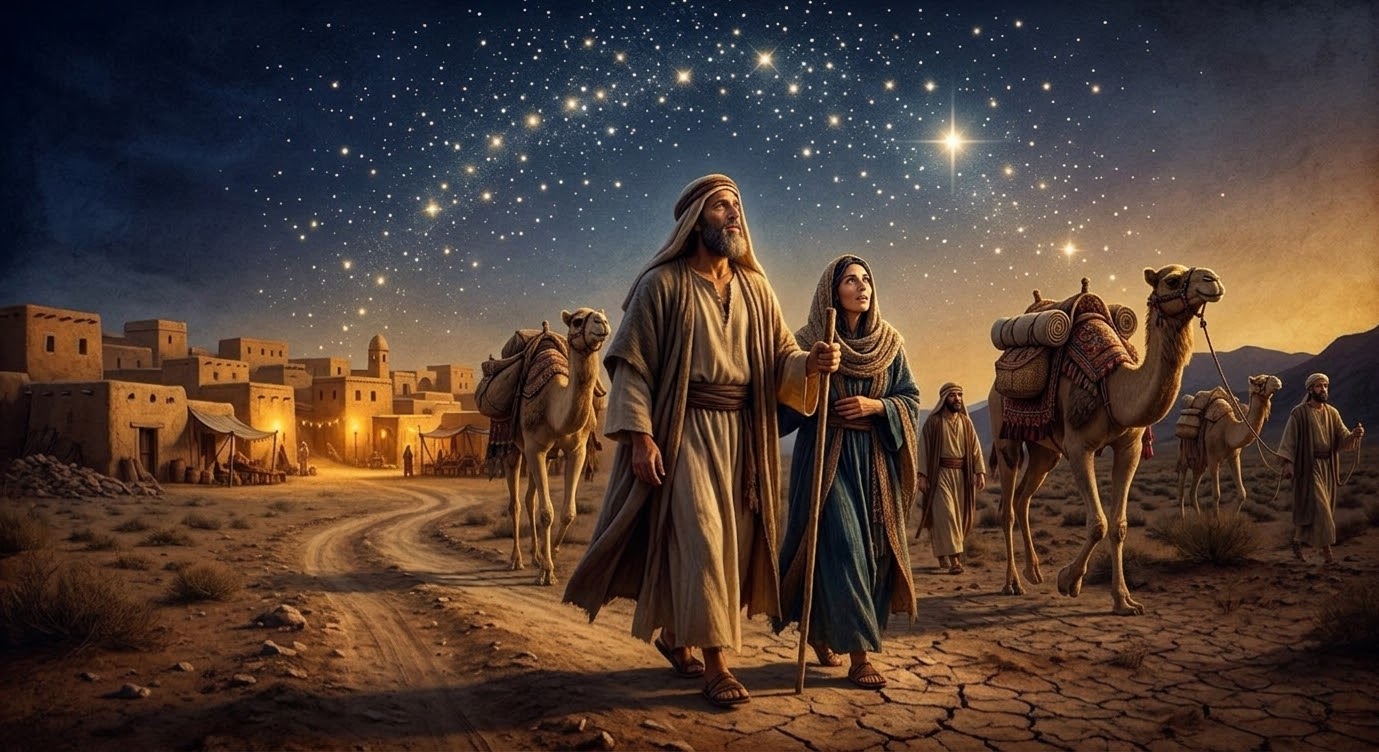
“Look now toward heaven and count the stars, if you are able to count them… So shall your offspring be.”
The Torah reveals here a powerful pedagogical tool used by the Creator Himself: visualization.
It is not simply about positive thinking or imagining material desires.
God takes a visible reality and uses it to strengthen an invisible promise.
He had already told Abram that his descendants would be like the dust of the earth. Now He shows him the stars of heaven.
Look. Observe. Contemplate. Internalize.
Faith needs to take root in the heart, but it often also needs an image that reminds it.
It is interesting to observe that a large part of modern personal-growth programs constantly insist on concepts such as “Visualize,” “See yourself achieving your goal,” or “Believe in yourself.” Yet it is rarely mentioned that visualization appears much earlier in the Torah.
It was the Eternal who said: “Look at the stars,” “Look at the dust of the earth,” “Lift up your eyes,” and “Walk through the land.”
But there is a fundamental difference: biblical visualization was never centered solely on the acquisition of goods or personal fulfillment. It was always linked to divine purpose and inner transformation.
That is why, years later, the Eternal will say to him:
“Walk before Me and be blameless.”
That condition is usually absent in many modern versions of visualization. The promise was never separated from character.
Is It Wrong to Ask for a Sign?
Abram also asks a question: “How shall I know that I shall possess it?” In other words, he asks for a sign.
Reading this passage, we might ask ourselves: Would it not have been better simply to keep believing?
Perhaps. But the Torah does not hide the humanity of its protagonists. Even the father of faith had moments in which he sought confirmation.
And if we are honest, many of us have done exactly the same. How many times have we said: “Lord, give me a sign,” “Show me if I am on the right path,” or “Confirm what I am feeling”?
Far from rejecting Abram, God responds by establishing the Brit Bein HaBetarim—the Covenant Between the Pieces. There He reveals to him that his descendants will go through a long period of exile and affliction before returning to the promised land.
The teaching is profound: the promise does not eliminate the process. God shows the destination, but He also reveals the path that will be necessary to travel in order to reach it.
Hagar and Ishmael: Two Questions for Every Soul
Faced with Sarah’s barrenness, a solution born of human impatience arises. Hagar conceives, and the situation generates tensions that end up leading her into the desert.
It is there that one of the most moving encounters of the entire parashah occurs. The Angel of the Eternal finds her by a spring of water and asks her two apparently simple questions:
“Hagar, servant of Sarai, where have you come from and where are you going?”
These words transcend the historical moment; they are questions directed also to us:
Where do we come from?
Who are we?
What stories, wounds, and decisions have brought us here?
And where are we heading?
Because it is not enough to be in motion; we must also know where our steps are leading.
Although Ishmael’s future will be marked by conflicts, Hagar discovers something extraordinary in the midst of her pain. She recognizes that God has seen her in her affliction. That is why she calls the Eternal El Roi—“You are the God who sees me.”
What comfort that revelation contains.
Before others understand us, God sees us. Before anyone hears our cry, God hears it. Before we find answers, God already knows our questions.
The Supreme Covenant: Identity, Integrity, and Transformation
When Abram is ninety-nine years old, the Eternal reveals Himself to him as El Shaddai and gives him an instruction that summarizes all spiritual life:
“Walk before Me and be blameless.”
He does not ask for perfection; He asks for integrity. He asks him to walk consciously in His presence.
From that moment, three fundamental transformations occur:
1. The change of name: Abram becomes Abraham; Sarai becomes Sarah. The change of name symbolizes a change of identity and destiny. God does not only transform circumstances; He transforms people.
2. The Brit Milah: Circumcision is established as the eternal sign of the covenant between God and Abraham’s descendants. The covenant ceases to be only an inner experience and is expressed in a visible sign of commitment and belonging.
3. The promise of Isaac: Finally, God declares that the spiritual inheritance and the covenant will be established through the son who will be born of Sarah.
The promise seemed impossible: Abraham was one hundred years old, and Sarah was ninety. Yet precisely there, where human possibilities end, the power of the Eternal begins to be manifested.
And Abraham responds as he had done from the beginning: obeying. Without delay, without negotiating, without postponing. That same day he fulfills the command he received.
Just as Abraham was called to leave his land in order to discover his destiny, each of us is invited to leave something behind: a limited identity, a wound, a fear, a dependence, or an old version of ourselves. The call of Lech Lecha remains in force because the spiritual journey never ends.
Conclusion: We Are Not What We Possess, but What We Transmit
Abraham’s life teaches us that true greatness is not measured by what we accumulate, but by what we leave as a spiritual inheritance.
Abraham was prosperous, but his legacy is not his flocks. He was respected, but his legacy is not his prestige. His greatness resides in having responded to the call of the Eternal when he still could not see the end of the path.
Lech Lecha continues to resonate in every generation as a personal invitation:
Go toward yourself.
Go toward the person you were created to be.
Leave behind that which limits your calling.
Walk with integrity.
Learn to trust when circumstances seem to contradict the promises.
And always remember that the greatest reward is not what we receive from God, but the possibility of walking with Him.
Because, in the end, the true promised land begins when a person decides to respond:
“Here I am.”

