Torah Reading
Noah: Genesis 6:9–11:32
Isaiah 54:1–10
Noah: Two Human Failures, Two Opposite Dangers
In the parasha of Noah, the Torah presents us with two models of social collapse.
The history of civilizations is not always interrupted by scarcity of resources or technological failure. Often, their fall begins much earlier: when the moral foundations that sustain human coexistence break down.
The Flood destroyed a society because people stopped respecting one another.
Babel destroyed a project because people stopped understanding one another.
The first failure was born of violence.
The second, of the breakdown of communication.
In one case, human dignity was trampled. In the other, language ceased to serve as a bridge between people.
Both accounts describe opposite but equally devastating dangers. And both contain surprising lessons for a generation like ours, marked by unprecedented technological advances and, at the same time, by growing difficulties in living together, listening to one another, and understanding each other.
The First Failure: Violence
Before the Flood, the earth was filled with violence.
Society disintegrated because people stopped respecting the dignity of others.
There was no lack of technology.
There was no lack of intelligence.
There was no lack of resources.
What was missing was the awareness that the other was also created in the image of God.
As Rabbi Sacks points out, the Flood is the description of what happens when moral law and the rule of law disappear.
What Hobbes called “the war of all against all” appears.
Lesson for 2026
Today, violence does not always take the form of weapons.
It can manifest as:
• destruction of reputations;
• hate speech;
• corruption;
• economic abuse;
• exploitation of the vulnerable;
• indifference to suffering.
The first lesson of Noah is:
A society is not destroyed because it lacks wealth. It is destroyed when it loses its moral compass.
The Second Failure: Babel
After the Flood it would seem that humanity had learned the lesson.
But now the opposite problem arises.
There is no longer disorder.
There is too much uniformity.
Everyone speaks the same language. Everyone thinks the same way. Everyone pursues the same project.
Let us look at their motives:
• Let us build a city.
• Let us make a tower.
• Let us make a name for ourselves.
• Let us not be scattered.
They were not building a tower to draw near to God. They were building a civilization in which the greatness of the collective nullified individuality.
The sin of Babel was the imposition of a single way of thinking.
Paradoxically, the generation that spoke one single language ended up losing what makes any society possible: the capacity to understand the other.
The tower did not collapse because of an engineering failure. It fell because language ceased to unite people.
Lesson for 2026
We live in a hyperconnected age.
It has never been so easy to communicate.
And yet:
• social media create echo chambers;
• algorithms reward uniform thinking;
• people fear being different;
• dissent is punished.
The danger is not only violence.
It is also conformity.
The Flood destroys freedom through the absence of law. Babel destroys freedom through excess of uniformity.
Why did they abandon the construction?
It was not a technical problem.
There was no shortage of bricks.
The tower did not fall.
What collapsed was communication.
The Torah shows here that the greatest human power is not force or technology.
It is language.
When language ceases to unite, every human construction ends up falling.
For our generation
We may have:
• artificial intelligence;
• satellites;
• global Internet;
• extraordinary scientific advances.
But if we lose the capacity to listen to one another, Babel repeats itself.
The true crisis of a civilization begins when people can no longer converse.
However, the parasha of Noah does not end with human failure. After the destruction appears one of the most hopeful images in the entire Torah.
The Wind of God
There is a detail that often goes unnoticed.
The waters do not disappear by themselves.
The Torah says:
“God caused a wind to pass over the earth.”
The same occurred in creation.
First appears the chaos. Then the spirit blows. Then order emerges.
Lesson
After every destruction there exists the possibility of reconstruction.
Chaos never has the last word.
For someone facing losses, failures, or uncertainties, Noah teaches:
Even when everything seems flooded, God continues to move invisible winds that prepare a new beginning.
The Difference Between Noah and Abraham
One of Rashi’s most profound comments revolves around a subtle textual difference:
Noah “walked with God.”
Abraham “walked before God.”
Noah was righteous.
Abraham was transformative.
Noah saved his family.
Abraham sought to transform the world.
The difference does not lie in the righteousness of one versus the other, but in the way they responded to their time.
Noah built an ark to survive the future. Abraham built a vision to create it.
Lesson for 2026
All of us, at some point, have waited for:
• a sign;
• an authorization;
• perfect conditions.
Yet the Jewish tradition proposes a different vision. Faith does not consist only in trusting in God; it also implies assuming the responsibility to act when the world needs reconstruction.
As a famous Midrash teaches:
“When it comes to rebuilding a shattered world or a broken dream, do not wait for permission from heaven. Heaven is already telling you to go ahead.”
Perhaps this is the great difference between Noah and Abraham.
Noah preserved what could be saved; Abraham built what did not yet exist.
The Covenant of the Rainbow: The Birth of Morality
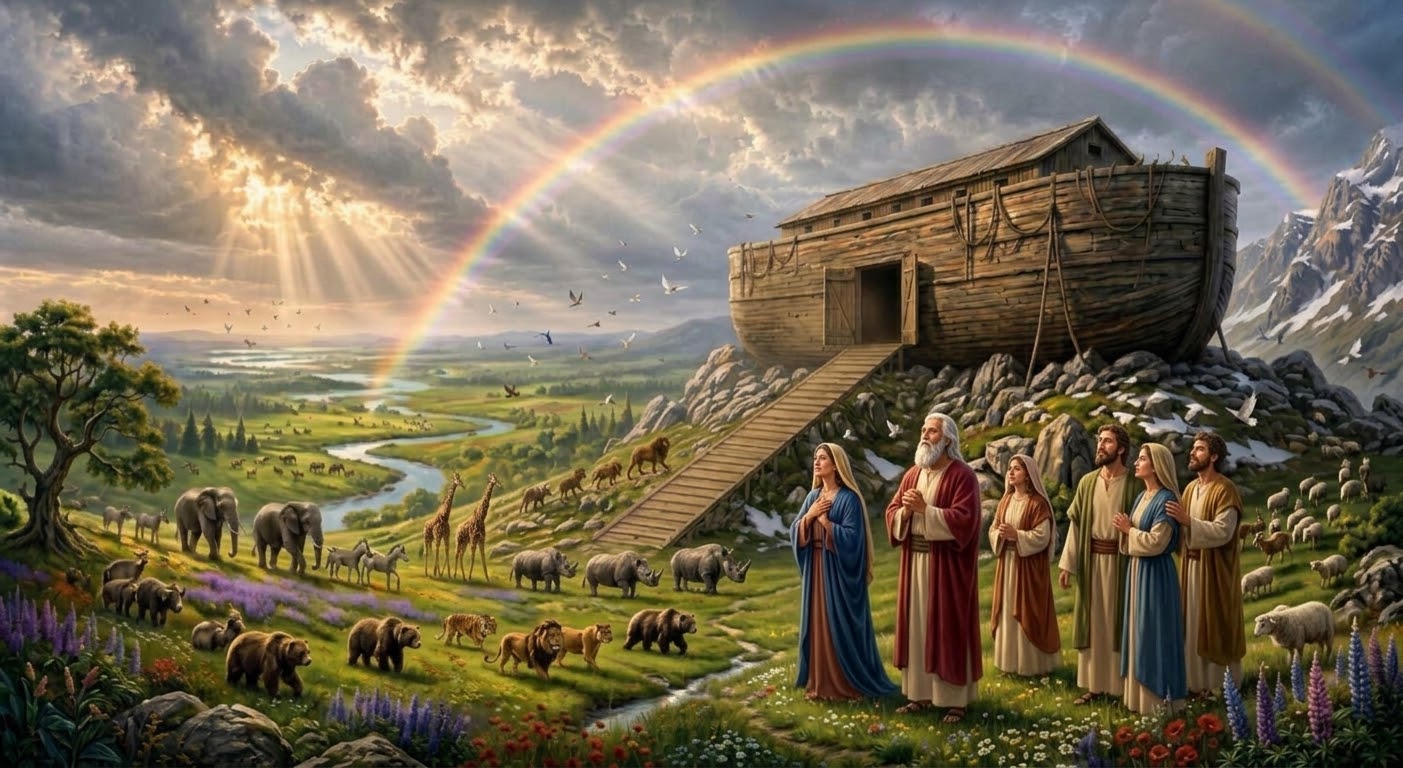
After the Flood, God establishes a universal covenant.
Not with Israel.
Not with a specific people.
With all of humanity.
The birth of morality.
In Genesis 1, man is created in the image of God.
That explains our capacities:
• to think;
• to speak;
• to create;
• to choose.
But in Genesis 9 a new dimension appears.
The other was also created in the image of God.
Therefore:
• we must not humiliate him;
• we must not murder him;
• we must not ignore his dignity.
Morality is born when I discover that the other possesses the same value as I do.
My message for the year 2026
Humanity fails when it loses respect for the person, for one’s fellow human being.
The Flood warns us about violence.
Babel warns us about uniformity.
Abraham teaches us the value of building something new.
The challenge of our generation is to remember both lessons.
To defend the dignity of every human being and to preserve the capacity to dialogue with those who think differently. Because a society can survive economic crises, technological changes, and even natural disasters. What it can hardly survive is the loss of respect and the breakdown of communication.
The Flood destroyed a society because people stopped respecting one another.
Babel destroyed a project because people stopped understanding one another.
Perhaps the task of our time is precisely the opposite: to learn once again to respect one another and to listen to one another.
“Faith is not waiting for God to rebuild the world for us. Faith is hearing God say: ‘I have placed the world in your hands. Now go and rebuild it.’”
Reference:
Haftarah Parashat Noah (Isaiah 54:1–10)
54 “1 Sing, O barren one, you who have not borne; break forth into singing and cry aloud, you who have not been in labor! For the children of the desolate one will be more than the children of her who is married,” says the Lord.
2 “Enlarge the place of your tent, and let the curtains of your habitations be stretched out; do not hold back; lengthen your cords and strengthen your stakes.
3 For you will spread abroad to the right and to the left, and your offspring will possess the nations and will people the desolate cities.
4 Fear not, for you will not be ashamed; be not confounded, for you will not be disgraced; for you will forget the shame of your youth, and the reproach of your widowhood you will remember no more.
5 For your Maker is your husband, the Lord of hosts is his name; and the Holy One of Israel is your Redeemer, the God of the whole earth he is called.
6 For the Lord has called you like a wife deserted and grieved in spirit, like a wife of youth when she is cast off, says your God.
7 For a brief moment I deserted you, but with great compassion I will gather you.
8 In overflowing anger for a moment I hid my face from you, but with everlasting love I will have compassion on you,” says the Lord, your Redeemer.
9 “This is like the days of Noah to me: as I swore that the waters of Noah should no more go over the earth, so I have sworn that I will not be angry with you, and will not rebuke you.
10 For the mountains may depart and the hills be removed, but my steadfast love shall not depart from you, and my covenant of peace shall not be removed,” says the Lord, who has compassion on you.

