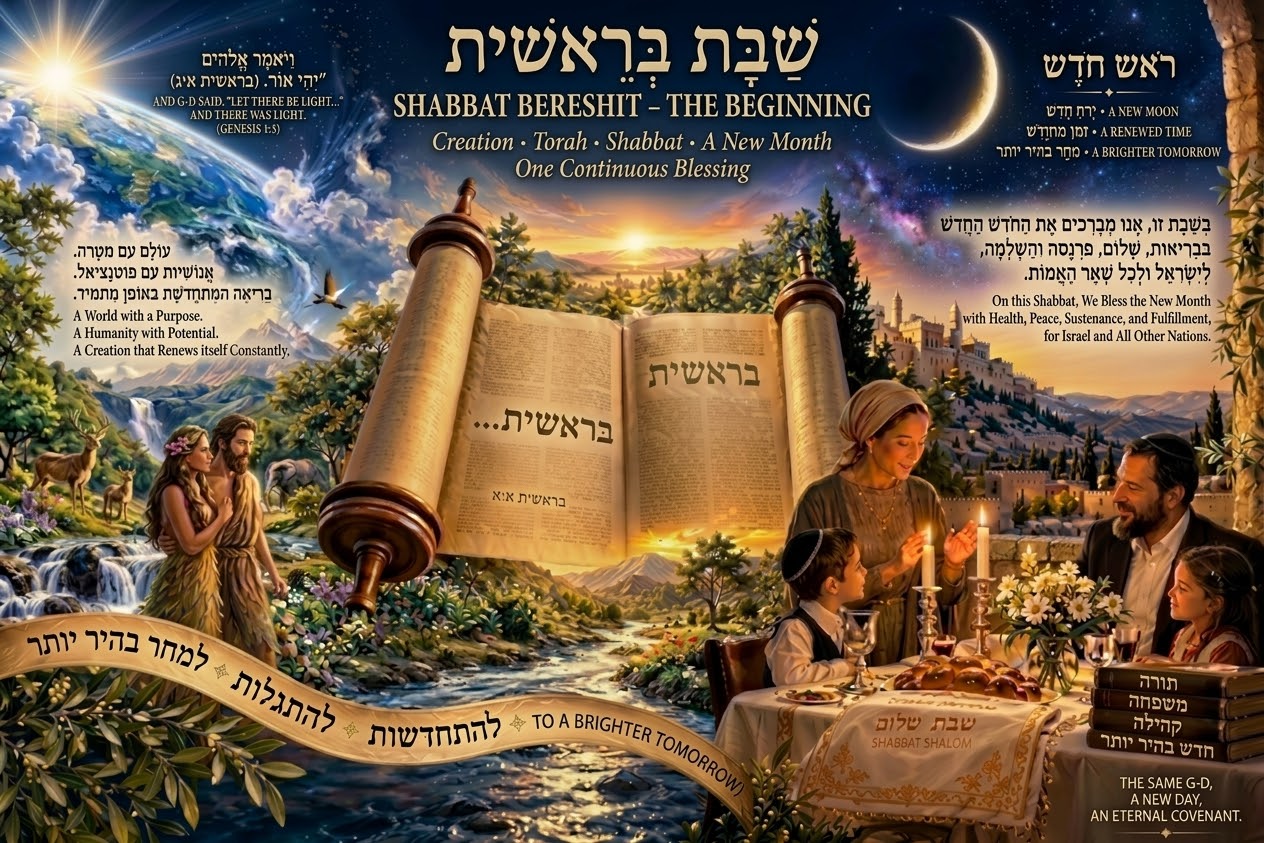
Shabbat Mevarchim – The Shabbat That Blesses the New Month
Parashat Bereshit
Reading: Genesis 1:1 – 6:8
“In the beginning G-d created the heavens and the earth.”
— Genesiss 1:1
Every year we return to read Bereshit. And every year we discover something new.
Many read this portion wondering how light was created, how the seas appeared, or how life began. However, looking at the world around us, it seems to me that the most urgent question is not how the world was created.
The question is:
What does it mean to be human?
We live in a generation that possesses more technology than any other in history, and yet seems to walk farther apart from one another, absorbed by individuality and the constant noise of a hyperconnected world.
We have more communication than ever, but fewer conversations.
More contacts, but fewer friendships.
More screens, but fewer eyes meeting.
More information, but less wisdom.
And that is precisely where Bereshit speaks to us once again.
The World Was Created with Words
The Torah repeats a phrase time and time again:
And G-d said…”
And then light appeared.
And the heavens appeared.
And the earth appeared.
Creation began with a voice.
Not with violence.
Not with force.
Not with weapons.
With words.
The first lesson of Bereshit is that words create realities.
A word can lift up a person who is down.
A word can destroy years of trust.
A word can inspire a generation.
If the Creator used words to bring order to the universe, what are we doing with ours?
Perhaps it has never been so important to teach our children to speak with respect, listen carefully, and use words to build rather than destroy.
We Were Created in the Image and Likeness of G-d
This is one of the most revolutionary statements in the entire Torah.
Human beings were not created by accident.
They were not created to simply exist.
They were created “in the image and likeness” of their Creator.
This does not mean a physical resemblance.
It means potential.
The capacity to love.
To create.
To choose.
To care.
To take responsibility.
Every human being possesses a dignity that does not depend on their wealth, social status, or achievements.
That is why it is so painful to observe a society that often seems to have forgotten the immense value of the human person.
The Creator’s Great Trust
There is something that always moves me in Bereshit.
G-d created the entire world.
The seas.
The mountains.
The animals.
The trees.
The seeds.
And then He entrusted all of it to human beings.
The most extraordinary fact is not only that He created the world.
The extraordinary thing is that He trusted that world to our stewardship.
He made us guardians of His creation.
Not absolute owners.
Not masters.
Guardians.
The question then is inevitable:
Are we taking care of the world entrusted to us, or are we simply consuming it?
The Seed: A Lesson for Our Generation
When reading Bereshit, the insistence of the Torah is striking:
“According to its kind.”
“With its seed in it.”
The seed appears over and over again.
Why?
Because the seed represents the future.
It represents continuity.
It represents heritage.
It represents the possibility of a next generation.
When I walk through modern supermarkets, I see more and more products advertised as “seedless.”
I do not intend to enter into agricultural, commercial, or scientific debates here.
However, the symbolism makes me reflect.
The Torah focuses on the seed.
On that which allows life to continue.
On that which guarantees that what was received can be transmitted.
And perhaps the deepest question is not only what happens to the seeds of the trees.
Perhaps we should ask ourselves:
What is happening to the spiritual seeds we pass on to our children?
What values are we leaving them?
What principles will they inherit?
What are we sowing every day in their hearts?
Values are seeds, too. Words are seeds, too. Acts of kindness are seeds, too.
The Silent Crisis of Our Time
Recently, I was talking to a taxi driver.
He mentioned something that made me think.
He said that as soon as many babies cry, a cell phone is immediately placed in their hands.
Technology is an extraordinary tool.
But no screen can replace a loving voice.
No app can replace a hug.
No video can replace the presence of a mother or a father.
Children discover who they are when someone speaks to them.
When someone listens to them.
When someone teaches them.
When someone tells them:
“I am here.”
“I love you.”
“You matter.”
Perhaps that is why the world began with a voice.
Because the voice creates bonds.
The voice shapes people.
Man and Woman: A Helper Opposite Him
The Torah declares:
“It is not good for man to be alone.”
How surprising.
In a universe where everything seemed perfect, G-d identifies something that is not good.
Loneliness.
So He creates a “helper opposite him.”
Not a servant.
Not a subordinate.
Not an identical copy.
But someone capable of accompanying, complementing, strengthening, and even challenging when necessary.
True unity is not about being identical.
It is about walking together toward a shared purpose.
Family appears in the Torah before any kingdom, institution, or economic system.
This is no small detail.
It is a teaching.
The Mistake of Adam and Eve
After eating from the forbidden tree, something deeply human happens.
Adam blames Eve.
Eve blames the serpent.
Neither fully takes responsibility.
Thousands of years later, we continue to do the exact same thing.
We blame governments.
Our parents.
Society.
Circumstances.
But maturity begins when we can say:
“I made a mistake.”
“I’m sorry.”
“I need to fix it.”
One of the great teachings of Bereshit is that personal responsibility is the beginning of spiritual growth.
Cain and Abel: The Inner Struggle
Before Cain commits the first murder, G-d warns him:
“Sin is crouching at the door, but you can master it.”
What a powerful message for the modern world.
The Torah acknowledges the existence of anger.
Of jealousy.
Of resentment.
Of frustration.
But it teaches something fundamental:
We are not obligated to obey our emotions.
We have the capacity to master them.
Human freedom is not doing whatever we feel like.
It is choosing to do what is right, even when we feel otherwise.
Walking with G-d
Among the figures in Bereshit, Enoch appears.
And something extraordinarily simple is said of him:
“And Enoch walked with G-d.”
It does not say he built great monuments.
It does not say he conquered territories.
It does not say he accumulated wealth.
It says he walked with G-d.
I have always explained this idea in a simple way.
When my son was young, I used to ask him:
“How would you behave if the principal of your school walked by your side all day?”
He would describe how he would speak, walk, and act.
Then I would tell him:
“That is walking with G-d.”
Living with awareness.
Speaking with awareness.
Acting with awareness.
Knowing that our decisions matter.
The Question Bereshit Leaves Us With
Perhaps the great question of this Parashah is not how the world was created.
Perhaps the real question is:
Are we raising human beings?
We have learned to build extraordinary machines.
But we do not always know how to shape human hearts.
We have connected entire continents.
But sometimes we have lost connection with those who sit at our table.
We have conquered knowledge.
But we continue to struggle with responsibility, humility, and love.
Bereshit reminds us that the first project entrusted to humanity was not a company.
It was not an empire.
It was not a technology.
It was a relationship.
A family.
A mission.
The same G-d who said, “Let there be light,” entrusted His creation into our hands.
And every generation must decide what it will do with that gift.
Perhaps the challenge of our era is to rediscover who we are, remember why we were created, and learn once again to walk with G-d amid a world full of noise.
Because when human beings remember their purpose, they also begin to illuminate the world.

