

Between Progress and Prudence: Reflections on Human Adaptation and Our Technological Future

The Creation, this vast and complex ecosystem we inhabit was designed for the delight and comfort of humanity. Yet, in our pursuit to thrive within it, we have demonstrated an astonishing capacity for adaptation. From the invention of air conditioning, which defies heatwaves, to the sophistication of mobile devices that warn us of earthquakes minutes before they strike, human ingenuity remains our greatest tool for resilience.

Today, Artificial Intelligence stands as an indispensable ally, shortening processes, optimizing resources, and potentially solving the enigmas that threaten our well-being. However, we must ask ourselves: Are we balancing this progress with the fundamental protection of our human integrity?

The Line Between Environmental Management and Fanaticism

It is concerning to observe how certain environmental policies in Europe have morphed into approaches that, far from protecting, compromise human physical and emotional well-being. The prohibition of air conditioning in public transport, for example, ignores a basic biological reality: the human body has physiological limits in the face of extreme heat. When a driver faints due to thermal stress, the system does not just fail it endangers the lives of passengers and pedestrians.

Similarly, in winter, the prohibition of using salt on roads to prevent falls under the guise of soil protectionis leaving a painful trail of fractures and severe injuries, especially among the elderly. When regulations ignore immediate human safety in favor of a rigid environmental ideal, the result is preventable suffering. We often search for someone to blame, but it is the policy itself that requires an urgent recalibration.

AI and the Infrastructure Challenge

Beyond energy efficiency, we must visualize how this technology translates into tangible well-being. This surplus heat, which today is dissipated as thermal waste, holds incalculable value for our communities:

 Heating Homes in Winter: Through thermal distribution networks, this heat can be circulated via pipelines to heat our homes, allowing families to face the harshness of winter with greater comfort and lower energy costs.

 Boosting Agriculture: Channeling this heat into specialized greenhouses allows for the optimization of crop cycles, ensuring a constant production of fresh food even in the most adverse climatic conditions

Parallel to these climate challenges, valid concerns have emerged regarding the thermal impact of the data centers that power Artificial Intelligence. It has been noted that these processing cores generate a thermal load that affects the ground and the local environment.

We cannot allow the engine that helps us advance to harm the very ground that sustains us. It is imperative that tech companies be transparent and proactive in relocating and optimizing these centers. They must be installed in optimal geographic areas where thermal dissipation is efficient and environmental impact is minimized through cutting-edge cooling technologies.

Hopeful Solutions: A Two-Fold Path

Faced with this scenario, I asked AI: Is there an immediate alternative while we work on long-term strategies? The answers are highly encouraging and prove that when technology is placed at the service of preservation, the horizon changes:

1. Liquid Immersion Cooling: Moving servers from air-cooled systems to tanks of dielectric fluid. This process is significantly more efficient, reduces energy consumption, and allows heat to be captured for reuse in urban heating.

2. Edge Computing: Decentralizing large data centers into smaller, distributed units. This reduces the thermal load at any single point and improves system latency.

3. Regenerative Energy Architecture: Designing data centers that operate as “batteries” for the local grid, leveraging renewable energy sources that align with climatic demands.

As citizens, we have the right and the duty to demand transparency regarding how this transition is being executed. We want to see, know, and understand the relocation plans for these infrastructures. Technological progress should not be a “blank check,” but a responsible alliance that respects our human dignity and protects our shared home.


Proverbs 2:6

For the Lord gives wisdom; from his mouth come knowledge and understanding.
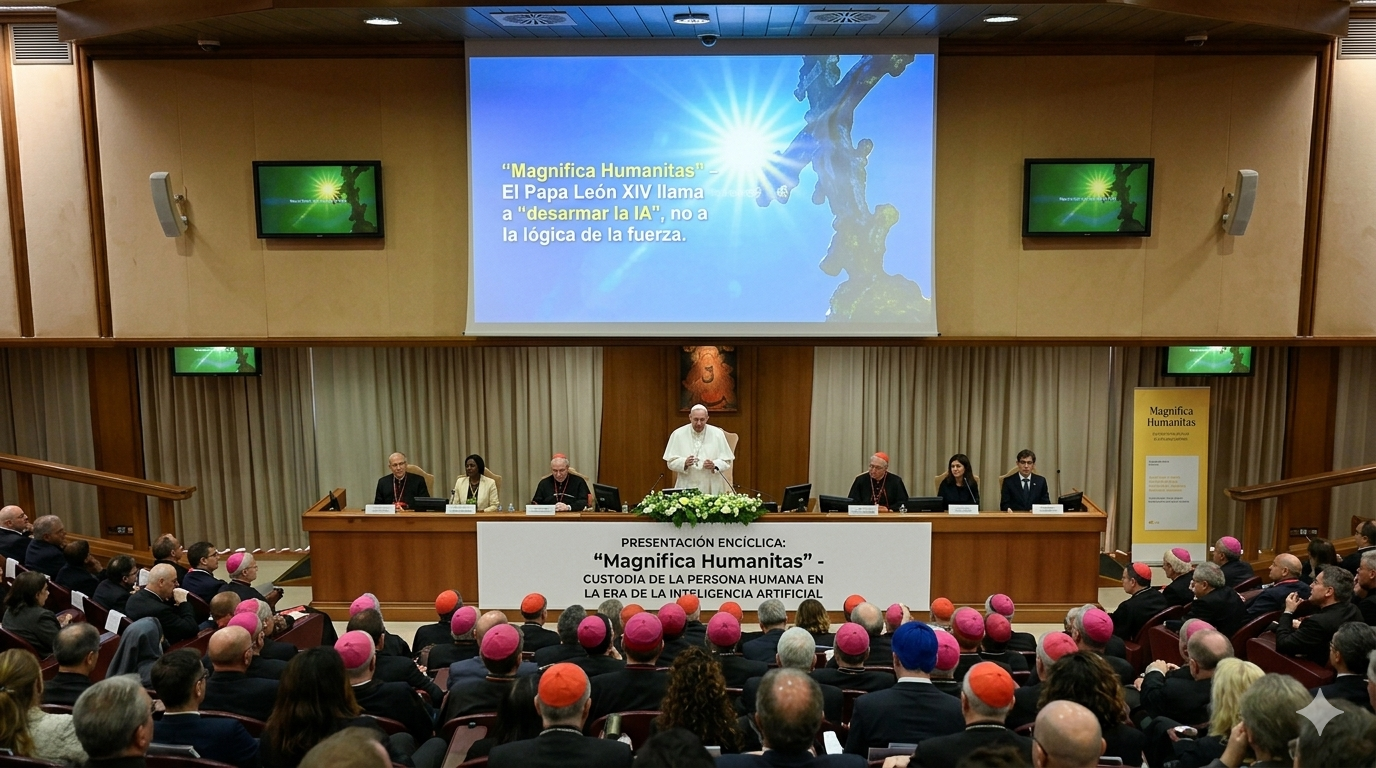
Disarming AI: The Pope’s Call and the Challenge of Feeding Technology with Ethics

Can Artificial Intelligence truly represent the perfect scales of justice, or does its success depend entirely on human conscience?

For the Eternal gives wisdom; from His mouth come knowledge and understanding.” > — Proverbs 2:6 (Mishlei)


Challenge of Feeding Technology with Ethics

The recent intervention by Pope Leo XIV regarding artificial intelligence has opened a crucial debate. When the Pontiff speaks of the need to “disarm” AI, he is not simply talking about turning off computers, but about removing its destructive potential in key areas, inviting us to an awakening of consciences.

This is a profound stance that touches the core of where we are headed as humanity, based on three essential pillars:

Ethics Over Autonomy: Technology is advancing by leaps and bounds, but technical speed does not always match ethical maturity. Algorithms lack conscience, morals, or empathy. If we allow crucial decisions—from economics to healthcare or justice—to be fully automated without human oversight, we risk dehumanizing society’s most vital processes.

Danger on the Global Stage: The use of AI in geopolitics and military security is already a reality. When systems capable of making lethal decisions autonomously are developed, the Pope’s analogy to the control of nuclear energy makes perfect sense. “Disarming” AI in this context means establishing firm international treaties to protect world peace.

“Awakening Consciences”: The most valuable part of this message is the invitation not to be passive spectators. Artificial intelligence must be a tool that enhances ingenuity, optimizes work, and brings us closer to collective success, but always under human control and purpose.

AI as the Scales of Justice: A Possible Ideal?

In theory, artificial intelligence processes cold data, laws, and facts in a purely objective manner, without fatigue, resentment, or the subjectivity that sometimes clouds human judgment. We could see it as the ideal representation of the classic scales of justice. However, the risk of “humanizing” it or blindly trusting it lies in a crucial nuance: the danger of automated impartiality.

For AI to act as that perfect scale, it depends entirely on the data it was trained on. If historical data contains past biases, prejudices, or unjust decisions, AI will not magically correct them; it will simply automate them on a large scale, becoming implacable but not necessarily just. Therefore, if we try to make AI emulate human emotions, it would lose the objectivity that makes it useful.

There is a vast difference between applying the law and achieving justice. True justice requires something that goes beyond cold mathematical logic: discernment and equity.

AI applied to the law can read a code and apply an exact sentence based on algorithms.

Human justice, on the other hand, analyzes context, intention, mitigating circumstances, and the possibility of redemption.

If we completely eliminate the human factor out of fear of error, we risk building a perfectly efficient but completely soulless justice system. The true success of this technology is not to replace our conscience, but to serve as that mathematical and incorruptible scale that assists people in making fairer, more transparent, and common-good-oriented decisions.

The Challenge of Human “Feeding”

Artificial intelligence does not generate its own moral values; it is an amplified mirror of the information and intentions of those who program and nurture it. This human “feeding” determines the success of the system on two critical levels:

1. Data Quality and Neutrality: If an AI is fed records that reflect inequality or disproportionate criteria, the machine will assume that is the correct pattern to follow. Instead of an incorruptible scale, it will become a tool that perpetuates human errors at high speed. Designing these systems demands extreme ethical rigor to clean out those biases.

2. The Intention Behind the Algorithm: Humans decide what the scale prioritizes, whether it is maximum economic efficiency or social well-being, equity, and the protection of the most vulnerable. The mathematical compass is always calibrated by a human heart.

Three Pillars for Strategic Action

At the end of the day, technology keeps the hope for a better future alive, but the responsibility remains in our hands. To ensure it is a true teamwork effort—machine precision combined with human nobility—we must rely on three pillars:

Constant Human Audit and Supervision: We must never leave AI on autopilot for decisions that affect people’s lives. The algorithm must function as a support assistant, but the final word and the signature must always belong to a responsible human being.

Diversity in Development Teams: To prevent an AI from reflecting the biases of a single group, the committees that design and feed these systems must be multicultural, multidisciplinary, and include experts in ethics, law, sociology, and human rights.

Creating “Transparency Filters”: “Explainable AI” systems must be demanded. The AI must not only provide a result but show step-by-step why it reached that conclusion. If humans can see the mathematical reasoning, they can immediately detect if the system is deviating.

The Role of Governments and Laws

Companies operate under the logic of the market and rapid innovation; therefore, the legal framework of governments is the only instrument with the legitimate power to establish clear, mandatory, and equal rules for everyone. Today, the legal approach is being structured across three fronts:

1. Risk-Based Laws: The most advanced regulations classify technology. If AI is applied in high-risk areas—such as justice, healthcare, or security—governments demand strict audits, absolute data transparency, and mandatory human oversight before it hit the market.

2. Data Protection and Intellectual Property: Legislation is being enacted to ensure that AI’s “feeding” does not come from the unauthorized scraping of private information or the work of human creators.

3. Clear Legal Accountability: Laws are making it clear that when an algorithm commits an injustice, the responsibility does not lie with the machine, but with the company that commercializes it or the institution that chose to apply it without proper supervision.

The true success of government laws is not to slow down progress, but to act like the brakes on a racing car: they are not there to make the car go slow, but to allow the driver to run at high speed with the confidence that they will not crash into the first curve. Establishing these legal boundaries is a crucial step to ensure that technology maintains a path of hope and collective benefit.

Psalm 8:3-6 (Tehilim)

When I consider Your heavens, the work of Your fingers, the moon and the stars which You have ordained, what is man that You are mindful of him, and the son of man that You visit him? For You have made him a little lower than the angels, and You have crowned him with glory and honor. You made him to have dominion over the works of Your hands; You have put all things under his feet.”