Children of Israel, listen with an open heart.
I bring to the table the very essence of our identity and the eternal covenant. Let us look at our present through the lens of the Torah and the prophets, connecting this week’s Parashat Matot-Masei (Numbers 30-36) with the cry of Jeremiah.
The Commitment of the Brothers and the Spiritual Shield
In this week’s Parashah, we clearly see the condition that Moses imposed on the tribes of Reuben and Gad: they could not sit idly by, enjoying their lands, while their brothers crossed the Jordan to fight. Their commitment had to be absolute.
Today, that very same battle is fought on two interdependent fronts:
The Physical Front: The soldier wielding a weapon on the border.
The Spiritual Front: The Chassid, the Torah scholar, the believer who chants the Psalms (Tehilim) with tears and joy, holding up the divine shield.
If the spiritual front shatters, the physical front is left defenseless. The Torah is explicit in Leviticus and Deuteronomy: Israel’s victory has never depended on the number of its tanks or the might of its men, but on the presence of the Eternal marching at the forefront. When Israel walks in pursuit of the commandments, “one chases a thousand, and two put a multitude to flight.” Conversely, when there is division and contempt for the sacred, our spiritual defenses collapse.
The Café in Jerusalem: The Breach in the Wall
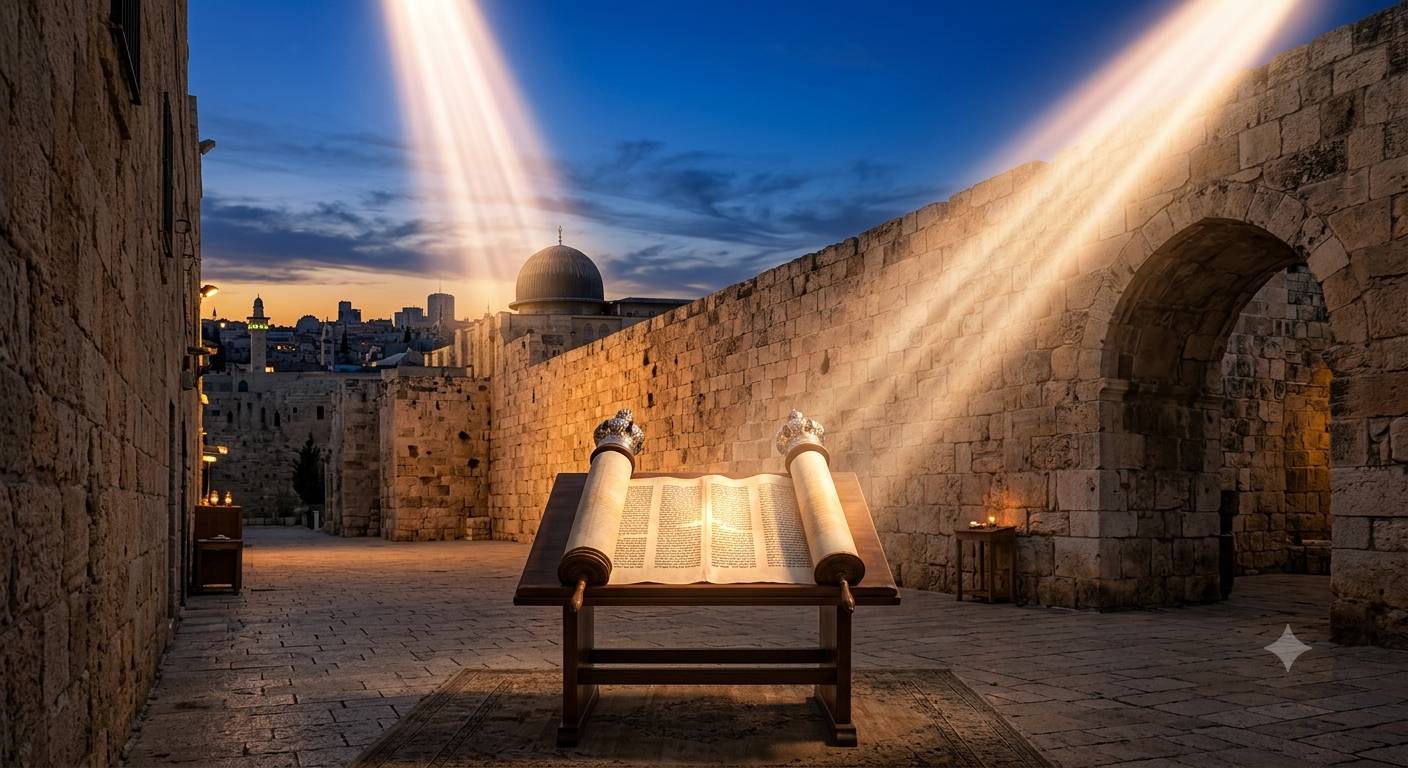
To witness Jew confronting Jew in the streets of Jerusalem over the opening of a business on Shabbat is a grief that shakes the heavens. This is not merely about a cup of coffee; it is about drawing a line in the sand. Jerusalem is not Tel Aviv. Jerusalem is the beating heart of the covenant, the city of the Great King.
Are we standing by as mere spectators to the beginning of commercialism in Jerusalem on Shabbat?
If Moses or the son of a High Priest were to stand today at the doors of that café, his voice would resonate like the Shofar at Sinai, echoing the words that the prophet Jeremiah proclaimed in those very streets:
Thus says the Eternal: Take heed for the sake of your lives, and bear no burden on the Sabbath day, nor bring it in by the gates of Jerusalem… but hallow the Sabbath day, as I commanded your fathers. But if you will not listen to Me to hallow the Sabbath day… then will I kindle a fire in its gates, and it shall devour the palaces of Jerusalem, and it shall not be quenched.” (Jeremiah 17:21-27).
The Warning of the Torah and Its Consequences
How would spiritual leadership plead today before the people and their rulers?
1. To the Business Owners and Citizens: Do you believe that assimilating into the nations will make you free? If Israel behaves like any other nation, it loses its raison d’être and its unique protection. To be a “Light unto the nations” (Or LaGoyim) requires maintaining a sacred distinction. Shabbat is the eternal sign between the Creator and His people; to trample it in Jerusalem is to strip the city of its seal of protection.
2. To the Authorities and Police: Using force to drag away those who defend the sanctity of the day of rest is a total violation of divine values. When the law of the land strikes down the guardians of celestial law, a spiritual vacuum is created, one that, historically, has preceded vulnerability to external enemies.
3. To the Religious Community: Defending the Shabbat is a duty, but it must be executed with the dignity of priests. Street violence tarnishes the holy incense. Zeal for the Eternal must inspire reverence, not mutual contempt.
The Final Message
The world looks to Jerusalem precisely because it seeks a beacon of holiness in the midst of an indifferent generation. If Jerusalem extinguishes its light by adopting absolute secularism and profaning the Shabbat, the world will no longer see the hand of G-d performing miracles.
When Israel attempts to rebel or ignore its divine design, the Eternal withdraws His protective hand, allowing the consequences of nature and neighboring nations to be felt; not as a destructive punishment, but as an urgent call to return (Teshuvah).
Let us remember that we still have brother soldiers on the borders, far from their homes and families, willing to lay down their lives to protect the inhabitants of Israel and Jerusalem.
Keeping our eyes fixed on righteousness, fulfilling our given word (like Reuben and Gad), and protecting the sanctity of Shabbat in the public square is not a theological option; it is the life insurance of the nation of Israel.
Shared Biblical Verses
Isaiah 49:6
He says, ‘It is too small a thing that You should be My Servant to raise up the tribes of Jacob and to restore the preserved ones of Israel; I will also make You a light to the nations so that My salvation may reach to the ends of the earth.
Deuteronomy 5:12-14
Observe the Sabbath day to keep it holy, as the Eternal your G-d commanded you. Six days you shall labor and do all your work, but the seventh day is a Sabbath to the Eternal your G-d; in it you shall not do any work, you, or your son, or your daughter, or your male servant, or your female servant… or the stranger who is within your gates, so that your male servant and your female servant may rest as well as you.
Deuteronomy 32:30
How could one chase a thousand, and two put ten thousand to flight, unless their Rock had sold them, and the Eternal had given them up?
Nehemiah 10:32
As for the peoples of the land who bring wares or any grain on the Sabbath day to sell, we will not buy from them on the Sabbath or on a holy day..


 Rita Sibbick